Showing posts with label tartan weaving. Show all posts

Tuesday, June 10, 2008

Wonderful Weaving Weekend


I have been meaning to try to catch up on various travels and events...but as my mind is not as linear as it once was, so goes my blog.

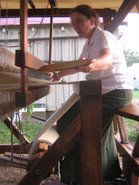
I just got back from 3 days of weaving at the home & studio of William Leinbach, who is a traditional Pennsylvania-German weaver and a friend. He lives with his wife Edna in Myerstown, PA, and he opened his studio to 5 weavers from the Blue Ridge Spinners & Weavers Guild and allowed us to weave samples on some of his looms.

We wove Overshot on 4 harnesses:


Overshot on 22 harnesses:

Doubleweave on 18 harnesses:

Summer & Winter on 6 harnesses: This is woven upside down, so you are looking at the "wrong side" of the fabric on the loom. Can you find my mistake?:


Singles linen plain weave on 2 harnesses:


Here is a finished linen kerchief that Bill wove in different colors -

Some weavers wove on a different 4 harness overshot and/or an M's & O's runner.

Most of Bill's looms are antique frame looms which are often called barn looms because of the massive beams that make up the loom. The 18 harness doubleweave was done on an old loom with a modern harness set added on; the 22 harness overshot was woven on a Glimakra Oxaback loom that Bill special ordered from Glimakra in Sweden some years ago.

Bill is a tall guy, a large man, and most of these warps were around 46" wide plus an extra few inches out each side to the cord that allows the weaver to add fringe by wrapping the pattern shuttle around the cord on every pass.

Which is to say, Really Wide for the average woman weaver - I'm 5'6", and I've been dealing with a torn rotator cuff and other shoulder issues for a year or more. I really wasn't sure if I would be able to work these looms comfortably with my shoulder. But I'm pleased to report that while it was certainly challenging, it didn't hurt to weave. I think I need to add this type of weaving to my weekly physical therapy schedule!

Bill has an awesome collection of spinning wheels, and contributed mightily to the wonderful book, Spinning Wheels & Accessories by David Pennington and Michael Taylor. There are old wheels all over the place!


I think he has too many wheels and should sell some to me, like this intriguing Canadian production wheel:

Or this beauty:

There are fascinating old things everywhere you look, like this collection of hats & bonnets hanging from a beam in the living room: We had a wonderful time weaving, visiting over potluck meals and going to the Black Angus antique market very early on Sunday morning. Some of we weavers bought antique coverlets there, and while I was tempted by an old spinning wheel, I didn't buy anything but really enjoyed looking. It's a wonderful market with all manner of old goods and some remarkable bargains.

Virginia, along with most of the East Coast, has been suffering a spell of very hot & humid weather. We don't have air conditioning at home, so our whole house fan has been working hard to keep us almost comfortable. Thankfully, the weather broke with a dramatic storm this afternoon, so we are looking forward to a more comfortable night of sleep.

I will take photos of my woven pieces when they are finished and share them with you in a later post.

Monday, November 26, 2007

Misty Mountain Tartan class

I want to share some of the wonderful tartans from the weaving class I taught at Misty Mountain Farm a few weeks ago. We had 9 students for the class, and each student brought a loom with the fine tartan warp threaded up and ready to weave. This is Gordon Regimental.
This is the warp for the MacLean tartan - quite a challenge for this new weaver.
This is the Anderson tartan - one of the most complex designs, with many color changes. The weaver is doing an excellent job of it!
This is a re-colored version of the Cunningham tartan. Sometimes these recolored tartans are really beautiful. I find the trick is to pay careful attention to the values of the original colors.
This is the famous Black Watch tartan.
This is the warp for Grant Hunting.

This is Cameron - the student has been practising a color repeat over and over before starting on the pattern proper.


Have you made it this far? Aren't the colors wonderful? I listened recently to Syne Mitchell's WeaveCast episode about Scottish Weaving, and I really enjoyed her description of how she discovered the beauty and excitement of tartan weaving. The weaving itself is relatively simple, just a straight 2/2 twill. The real excitment is in the colors; the bright, dynamic warp, and the many color blends that are created as the weft colors cross over the warp threads.


I love fair isle knitting, watching the color patterns form and reform under my needles. It is much the same with tartan weaving.


And I love teaching tartan weaving, sharing this delightful traditional design form with students and watching their excitement and confidence grow. It really isn't as hard as it looks...

Wednesday, April 11, 2007

Visiting Penland


My friend Beth Johnson is teaching an 8 week fiber intensive class at the Penland School of Crafts in North Carolina. She invited me to come down to be a guest instructor for 2 days and although the timing was tough, my husband and my work partner said I had to go - so I went!

Spring is a wonderful time to drive south. Every hour brings new species in bloom. I got so excited when I spotted the first redbud blooming! Here is a view from the school:

And the weaving studio:
My primary role was to conduct a wool waulking - the traditional Scottish method of finishing wool tweed and blanketing after it comes off the loom. The web is sewn end to end into a loop and wetted thoroughly. Then it is placed on a table, and a group of people grasp the cloth, thump it down on the table and pass it to their neighbor, in a sunwise or clockwise direction. The rhythm is maintained with songs sung to a steady beat: the singer sits or stands at the head of the table and starts the song. The songs generally have a chorus, which the participants join in.

We had lots of cloth to waulk:

And we had a blast, singing, thumping, laughing. There were libations, and snacks - Marge Warren supplied shortbread and haggis rolls! Here is Marge in her traditional garb:

Marge and Beth both teach at the Campbell Folk school - that is how we met. They both teach tartan weaving, among other things. Marge very generously shared with me her notebook from her District Checks class. I am planning a Tweeds & District Checks class to teach the The Mannings this fall, and I was glad to see her work and talk with her about yarn sources.

I also did lecture/demos each morning on 18th c. rugs, Acadian weaving traditions, and early linen weaves.

Beth has studied weaving in Japan, and the students were wrapping skeins of cotton for Kasuri ikat weaving. I wound a set of skeins and dipped them in the indigo pot and brought them home to weave sometime. Ikat is a fascinating tradition - I just love the cloth. Here are skeins ready dyed and a student sample on the loom:

Beth had a book a fabric samples from one of the studios where she had studied.


I'm going to try to get her to come up to Virginia and teach a class on Kasuri/ikat dyeing and weaving. Anyone want to come?


Here are my skeins drying on the clothesline and the bucket with all the resist ties - I liked the way they looked...